Isomorphic Software-Defined Automation
Understanding the 1:1 structural and causal mapping between physical systems and software
Complete Architecture Overview
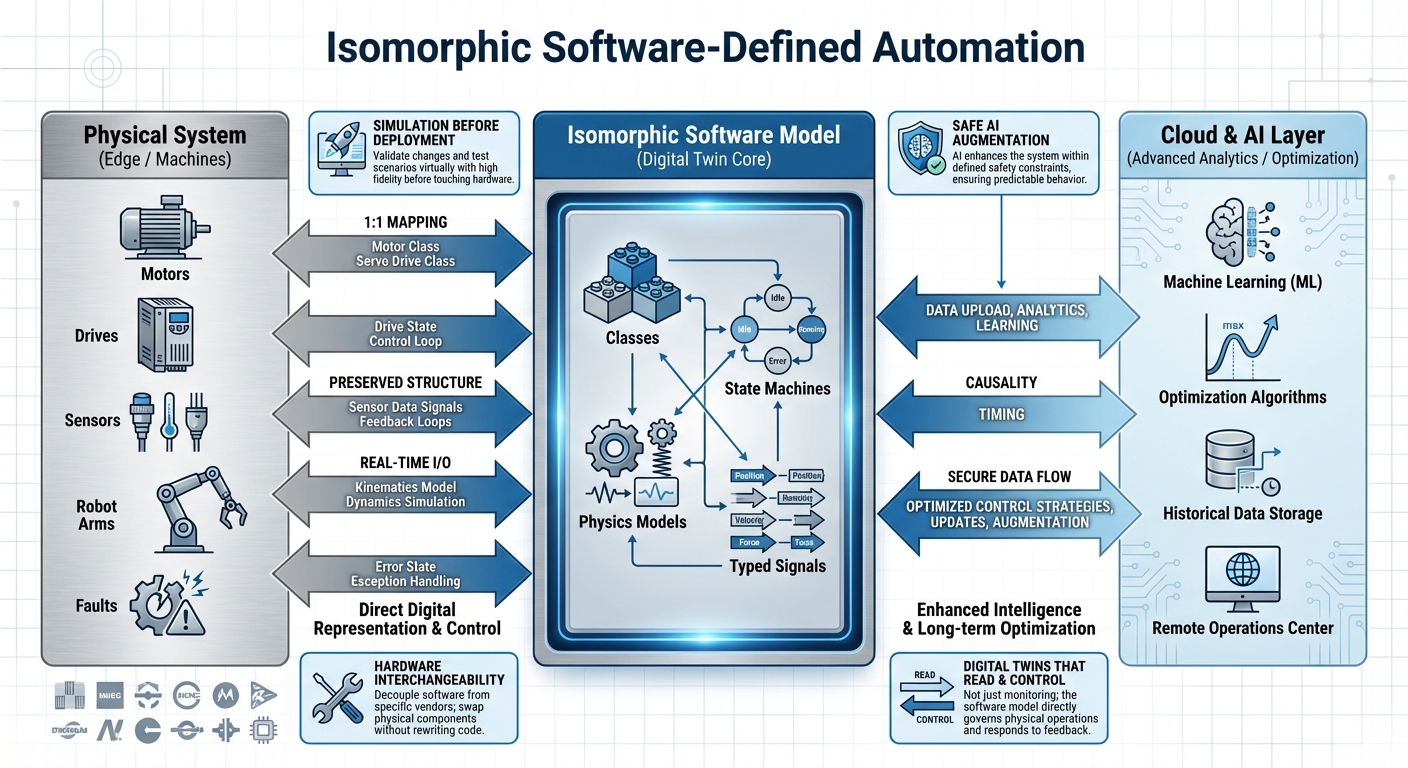
The DigiPhusion platform maintains an isomorphic relationship between physical automation equipment and software models. This enables simulation-before-deployment, hardware interchangeability, and deterministic control.
Core Principles
1:1 Structural Mapping
Every physical device has exactly one software representation. The software hierarchy mirrors the physical hierarchy.
Causal Relationships
The system models cause-and-effect, not just correlations. Rules encode physics and engineering constraints.
Same Model Everywhere
Identical code runs on cloud (simulation), edge (real-time), and dashboard (monitoring). No translation layers.
System Layers
Physical System (Edge / Machines)
Motors, drives, sensors, robot arms, and other industrial automation equipment
Components
- • Motors and actuators
- • Drives and control hardware
- • Sensors and feedback loops
- • Robot arms and mechanical systems
Key Features
- • Real-time I/O with kinematics models
- • Hardware interchangeability (swap devices without code changes)
- • Error state and exception handling
- • Direct digital representation and control
Isomorphic Software Model (Digital Twin Core)
Software representations with state machines, physics models, and typed signals
Components
- • Classes (Motor, Drive, Sensor)
- • State Machines (Procedure, Operation, Phase)
- • Physics Models (kinematics, dynamics)
- • Typed Signals (with quality indicators)
Capabilities
- • Simulation before deployment (validate changes)
- • Preserved structure (sensor data, feedback loops)
- • Real-time I/O with dynamic simulation
- • Error state exception handling
Cloud & AI Layer (Advanced Analytics / Optimization)
Machine learning, optimization algorithms, and long-term data analysis
Components
- • Machine Learning (ML) models
- • Optimization algorithms
- • Historical data storage
- • Remote operations center
Safe AI Augmentation
- • Data upload, analytics, learning
- • Causality and timing preservation
- • Secure data flow
- • Optimized control strategies and updates
Digital Twins That Read & Control: Not just monitoring—the digital twins govern physical operations and respond to feedback. They maintain bidirectional control loops that ensure physical reality matches commanded state.
Key Benefits
Hardware Interchangeability
Decouple software from physical components. Swap motors, drives, or sensors without rewriting code—the isomorphic model adapts automatically.
Simulation Before Deployment
Test changes in virtual environments with high-fidelity physics before deploying to production. Catch issues early without risking equipment.
Intelligence Portability
The same control logic runs on edge devices, cloud servers, or local machines. Move workloads seamlessly based on latency, compute, or connectivity needs.
Deterministic Debugging
Replay production failures exactly in simulation. The isomorphic model preserves causality, making root cause analysis straightforward and reproducible.
Learn More
Explore detailed documentation about the isomorphic architecture